
How to Find St. Louis County Arrest Records
St. Louis County arrest information lives in three places. The arresting agency holds the original police report and arrest narrative. The county jail holds the booking record while the person is in custody. The prosecutor and Circuit Clerk hold the formal charge and criminal court case once one is filed. Most St. Louis County felony and misdemeanor charges are prosecuted by the St. Louis County Prosecuting Attorney, currently Melissa Price Smith, and filed in the 21st Judicial Circuit.
For an arrest by the St. Louis County Police Department, the Central Police Records Unit at 7900 Forsyth Blvd., Room B-013, in Clayton, is the office that releases reports, runs sex offender registration, handles concealed-carry permits and accepts Sunshine requests for police records. A look at the official Central Police Records page is the cleanest reference for what the unit handles.
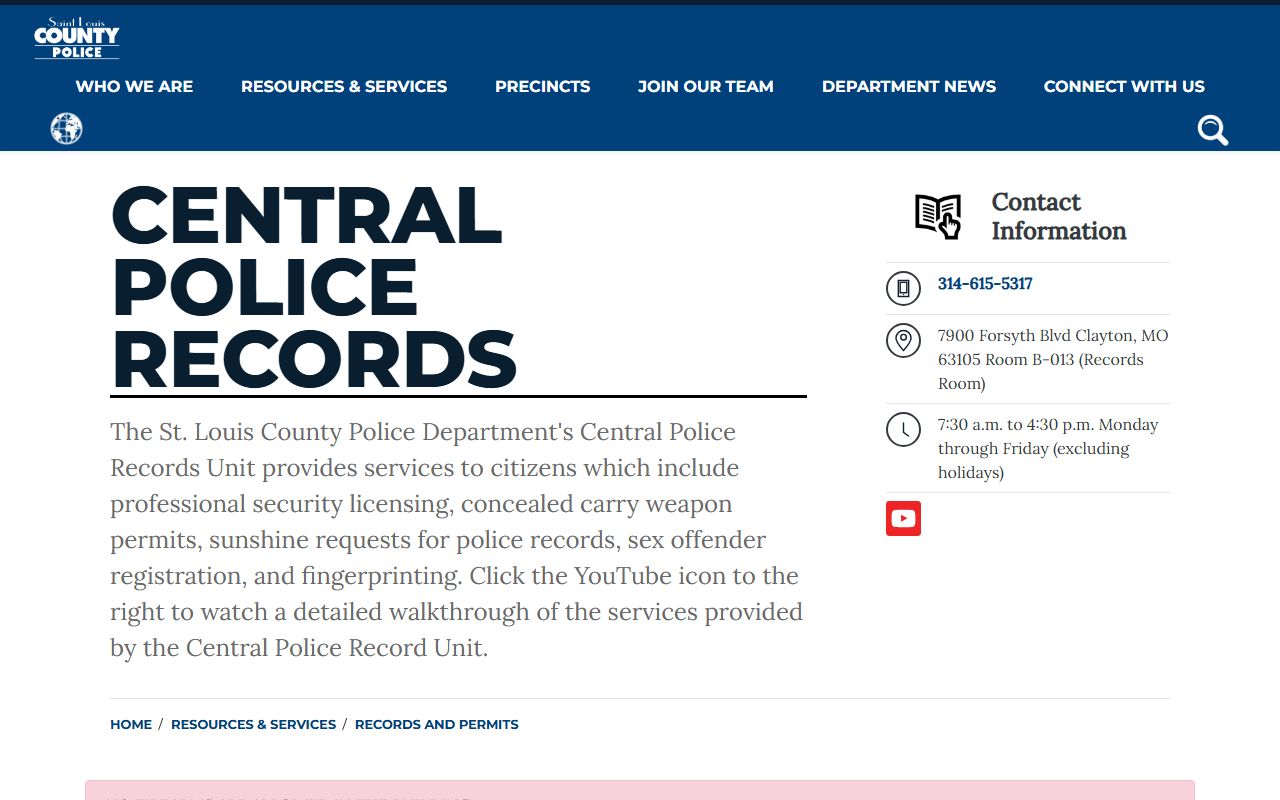
The records page lists hours, address and fingerprinting services. Many other municipalities inside St. Louis County run their own police departments; the Records Unit only releases records for arrests its officers made.
- Identify the arresting agency. The arrest report comes from that agency, not from the county courthouse.
- Submit a records request to that agency. For St. Louis County PD, use the Central Police Records Unit or the county Sunshine portal.
- Check Missouri Case.net for a filed criminal case. Use the person's name, date of birth window or case number.
- For someone still in custody, contact the Department of Justice Services at 314-615-5245 with the inmate's full name and date of birth.
- For released-inmate verification or notifications, use VINELink at vinelink.com.
- For state prison custody, search the Missouri DOC offender locator. For federal custody, use the BOP locator.
St. Louis County Police and Arrest Records
The St. Louis County Police Department covers unincorporated St. Louis County and provides contract police service to several municipalities. The department also handles backup, specialty units and county-wide crime data. The official department site links resources for jail inmate information, records and permits, and concealed-carry permits.
From the department homepage, the resources menu carries the records and permits link and the jail inmate information link. Both are good launch points before phoning the records counter.
Central Police Records Unit
7900 Forsyth Blvd., Room B-013
Clayton, MO 63105
314-615-5317
Mon-Fri 7:30 a.m. - 4:30 p.m. (excluding holidays)
Department of Justice Services / Jail
100 South Central Avenue
Clayton, MO 63105
314-615-5245
Jail open 24 hours
Many cities inside the county run their own police forces and their own records units. An arrest by a municipal officer goes through that city, not the county. Confirm the arresting agency before mailing a request.
St. Louis County Booking and Intake
An arrest in St. Louis County moves through a predictable sequence. The arresting officer takes the person into custody and transports them to the St. Louis County Jail / Buzz Westfall Justice Center at 100 South Central Avenue in Clayton. Justice Services intake covers identification, property inventory, medical and mental-health screening, fingerprinting, photographing and housing classification.
- Arrest by city or county law enforcement, or warrant pickup.
- Transport to the St. Louis County Jail at 100 South Central Avenue.
- Intake identification and biometric processing.
- Medical and mental-health screening at booking.
- Property inventory and housing classification.
- Initial bond, if set, may be posted at intake or after first appearance.
- Charges, if filed, route to the prosecutor for review and appear in Case.net after filing.
Booking happens 24 hours a day. The publicly visible record of a recent arrest may lag behind the booking itself; the county does not publish a real-time online booking list. To confirm someone is in custody, call Justice Services with the person's full name and date of birth.
What St. Louis County Arrest Records Show
An arrest record is not the same as a criminal court record. The arrest report is the police narrative, and the booking record is the jail intake file. The criminal court record comes later, after charges are filed. The fields below summarize the public-facing items typically released through county police records, statewide custody systems and Case.net.
| Field | What It Shows |
|---|---|
| Arrestee name | Full legal name from booking, with known aliases. |
| Year of birth | Year only; full birthdate is redacted from court display. |
| Arresting agency | County police, city police or other Missouri agency. |
| Arrest date / time | Date and time the person was taken into custody. |
| Charges | Listed offenses with Missouri statute and violation code. |
| Booking number | Internal jail identifier; used by Justice Services for inmate lookup. |
| Offense cycle number | Statewide criminal-history identifier used by Case.net. |
| Bond amount | Set bond, if any. Cash-only, surety or property-bond options vary. |
| Case number | Assigned once the prosecutor files a charge in court. |
| Hearings | Initial appearance, preliminary hearing and arraignment dates. |
| Disposition | Updated as the case moves through the 21st Judicial Circuit. |
Sealed cases, juvenile cases and expunged records are not in this list. Victim, witness and child identifiers are redacted under court rules. Photo booking images are not posted on a county website.
Arrest Records vs Criminal Court Records
Many users mix up an arrest record with a criminal court record. They are different documents at different points in the case. The table below sums up the practical difference.
| Point | Arrest Record | Criminal Court Record |
|---|---|---|
| Who creates it | Arresting law enforcement agency | Circuit Court of the 21st Judicial Circuit |
| What it shows | Police narrative, charges at arrest, booking data | Filed charge, plea, motions, judgment, sentence |
| Where to find it | Police records unit, jail booking | Case.net and the Circuit Clerk |
| Result if dropped | Arrest still recorded; expungement may apply | Case may be dismissed or never filed |
| Best link | Central Police Records | Court records page |
An arrest is not proof of guilt. Missouri practice and federal due process treat the person as not guilty until a court enters a judgment of conviction. A dismissed charge or a not-guilty verdict in the 21st Judicial Circuit can be the basis for an arrest-record expungement under RSMo § 610.123.
Public Access and Privacy for St. Louis County Arrest Records
Court records run under Missouri Court Operating Rule 2, which presumes openness unless a record is confidential by statute, court rule or court order. Police records run under the Missouri Sunshine Law in Chapter 610. Some arrest material is closed: investigative records open until the case is closed under RSMo § 610.021, juvenile records under RSMo § 211.321, expunged records under RSMo § 610.140 and corrections health information under RSMo § 217.075.
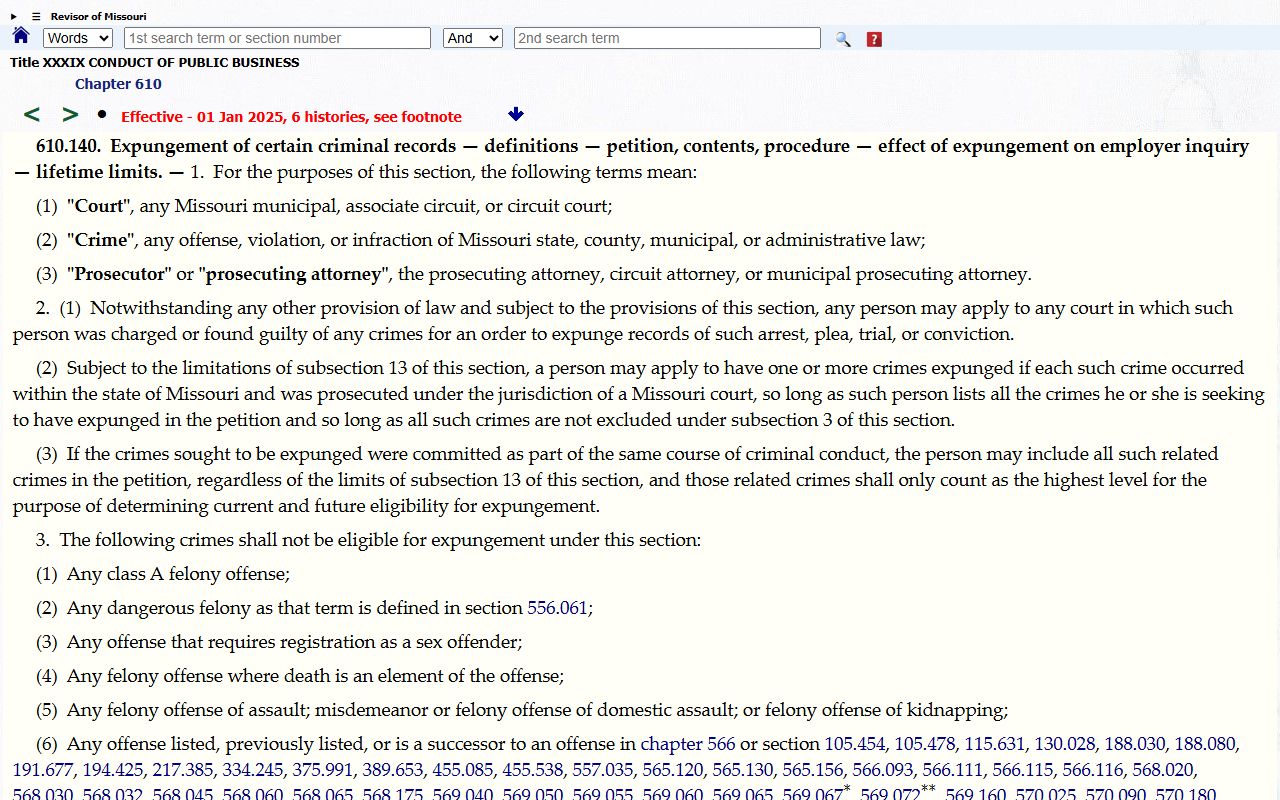
The expungement statute defines what records can be closed by court order and how the court must serve the order on every agency named in the petition. Read it in full before filing.
Under RSMo § 610.023, the records custodian must respond to a Sunshine request as soon as possible and no later than the end of the third business day. Fees follow RSMo § 610.026: paper copies up to ten cents per page for normal-size paper, plus clerical time at the average hourly rate.
Note: A Sunshine request goes to the agency that holds the arrest record; the courthouse cannot release a police report from another department.
Sealed vs Expunged St. Louis County Arrest Records
Closing a record in Missouri is not a single action. Sealing limits public access but the record still exists. Expungement under RSMo § 610.140 directs every named agency to close the record so it cannot be released to most requesters. Mistaken-identity expungement under RSMo § 610.145 applies when the wrong person was tied to a record. Each remedy has its own eligibility and its own petition format.
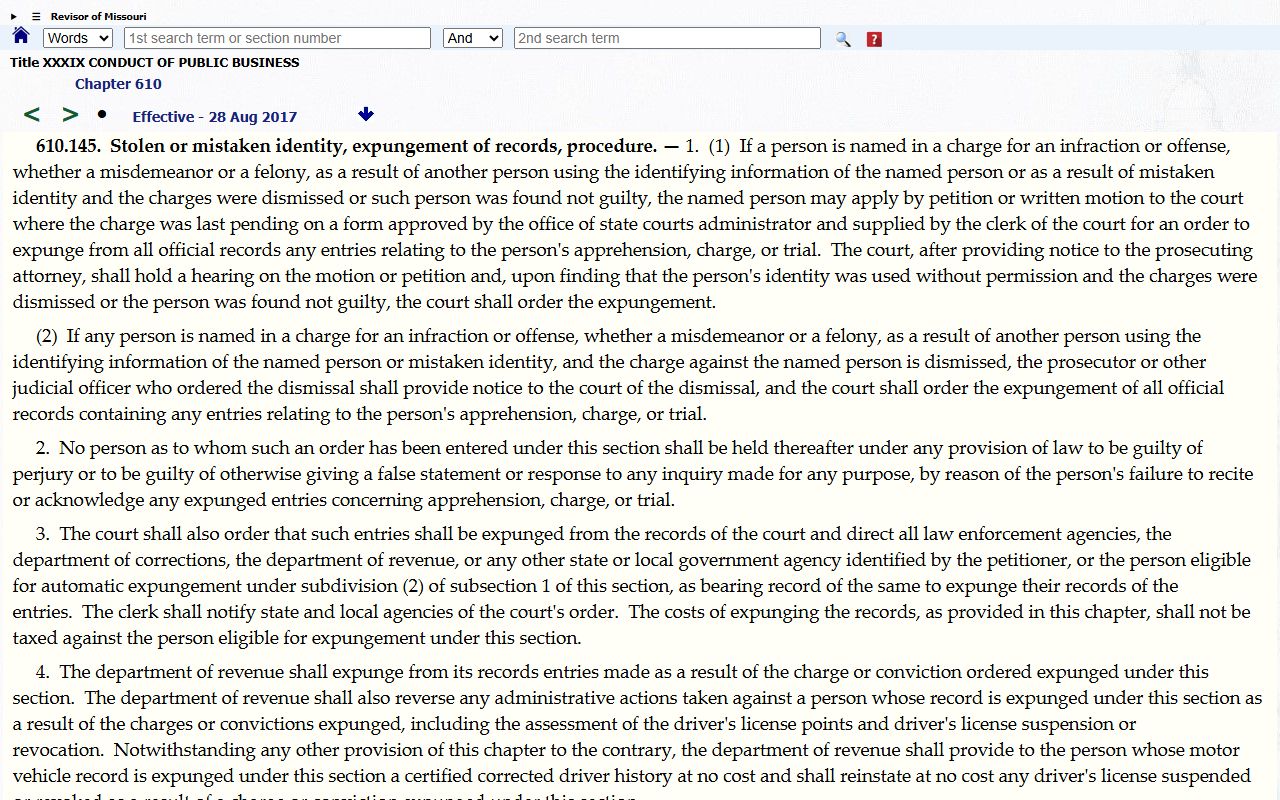
Mistaken-identity expungement is the remedy when someone else's arrest was tied to your name through misuse of ID or clerical error. The St. Louis County fee schedule lists no deposit for this filing.
| Remedy | Statute | St. Louis County Filing Deposit |
|---|---|---|
| Conviction expungement | RSMo § 610.140 | $355.50 |
| Arrest record expungement | RSMo § 610.123 | $105.50 |
| Mistaken identity | RSMo § 610.145 | No deposit |
The fee schedule is published by the 21st Judicial Circuit Circuit Clerk. A petition that names every law-enforcement agency that holds the record is the fastest path to a full closure; missing an agency leaves a record open at that agency.
Sex Offender Registry and Background Considerations
The Missouri State Highway Patrol runs the public sex offender registry at mshp.dps.missouri.gov/CJ38/Search. Registration is a separate process from arrest reporting; the St. Louis County Police Central Police Records Unit handles county-level sex offender registration.
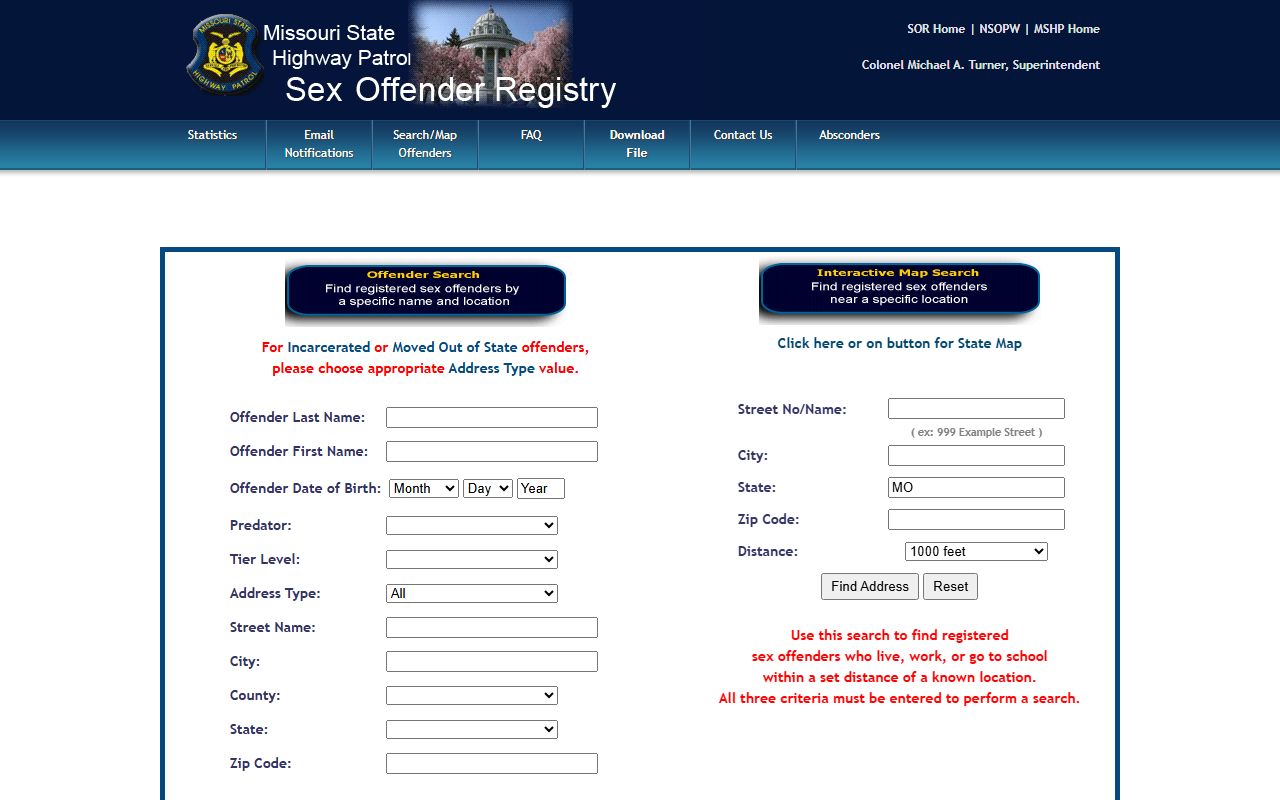
The registry supports name, date-of-birth and address-radius searches. The official MSHP program page explains who must register and how compliance checks work.
Background checks for employment, licensing or tenant screening typically pull from court files, the Missouri State Highway Patrol Criminal Justice Information Services and federal sources. The 21st Judicial Circuit cannot remove a record on its own; expungement requires a petition.
Federal and State Criminal Records
Some arrests in St. Louis County route to federal court. The U.S. District Court for the Eastern District of Missouri at 111 South Tenth Street in St. Louis handles federal criminal cases. Federal records are searched through PACER's CM/ECF lookup, not Case.net.
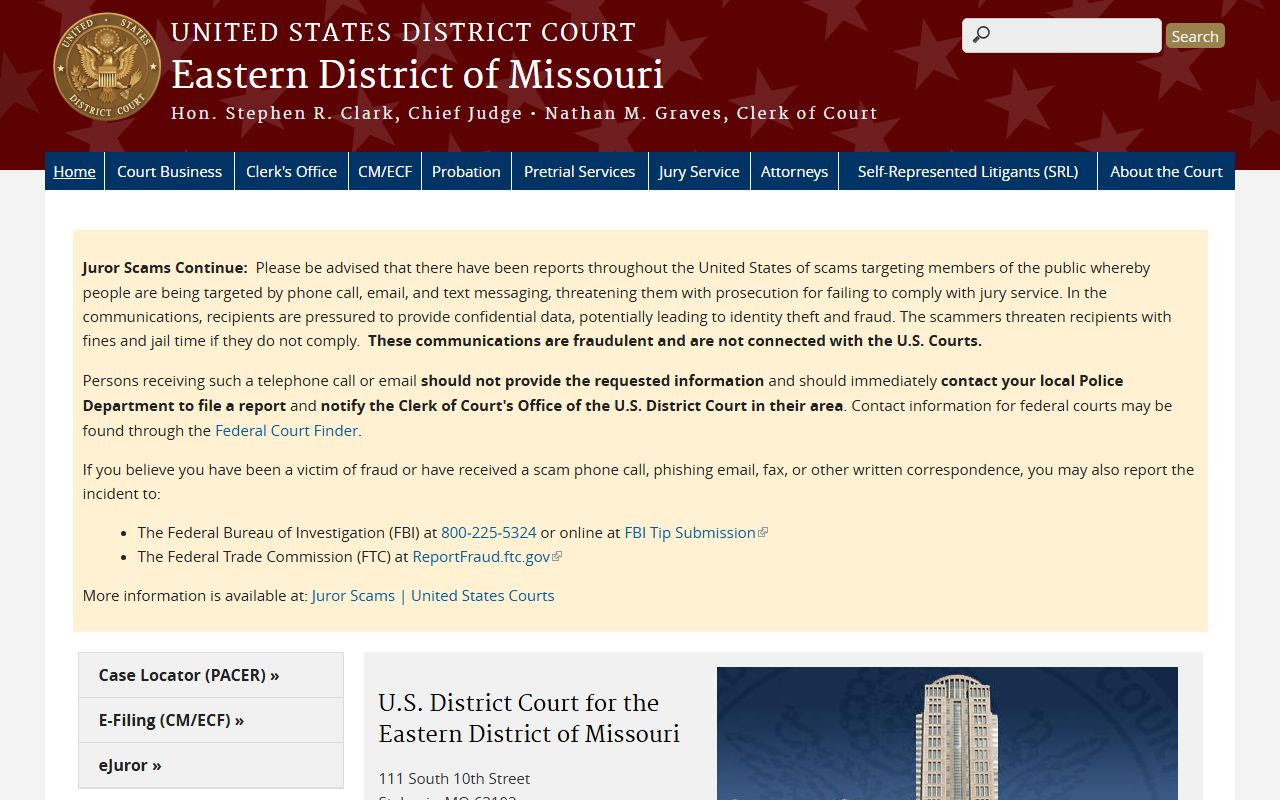
The U.S. Attorney's Office for the Eastern District of Missouri prosecutes federal cases out of St. Louis. Federal arrest information is held by the FBI, ATF, DEA or other federal agency that made the arrest, then by the U.S. Marshals Service for federal custody.
State prison records are held by the Missouri Department of Corrections, searchable through the DOC offender web search. Probation, parole and discharged status appear in different DOC products.