
How to Search St. Louis County Warrants
Missouri Case.net at courts.mo.gov/cnet is the starting point. A warrant entry appears on a case docket once the case itself is public. The 21st Judicial Circuit posts the Find My Case link on its homepage, but the actual docket lives in Case.net. The portal supports name search, case-number search and scheduled-hearings search; warrants tied to existing cases turn up under any of those paths.
- Open Case.net and pick a search method. Litigant Name and Case Number are the most useful for warrant lookups.
- Choose 21st Judicial Circuit / St. Louis County to narrow results to this circuit, or run statewide.
- Enter the person's full name or case number. Click Search.
- Open the case and click the Docket Entries tab. Look for entries that read warrant issued, warrant served, warrant recalled, capias issued, capias pro fine or bench warrant.
- If the warrant is municipal and the case does not appear, call the city's municipal court directly. Case.net only carries municipal divisions on Show-Me Courts.
- Talk to a defense attorney or the public defender if criminal exposure exists before walking into the courthouse.
The 21st Judicial Circuit Court main number is 314-615-8029. The court does not give legal advice over the phone, but the clerk can confirm whether a warrant exists on a public case and what the next court date is.
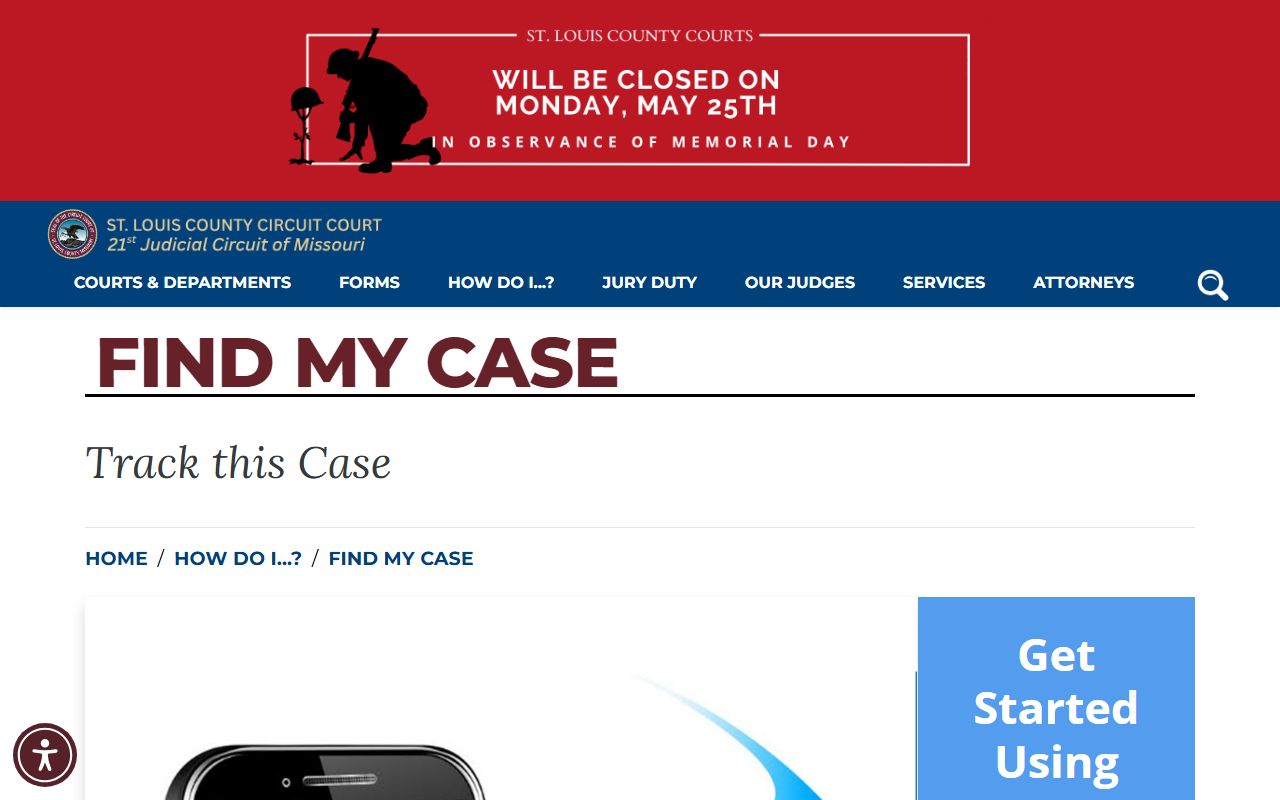
The Find My Case page routes users straight into Case.net. It is the bookmarked launch point from the local court site.
St. Louis County Warrant Search Fields
There is no separate warrant-only search form on the official county site. The Case.net fields below are the ones the public uses to find a warrant entry on a docket. Field labels follow the Missouri Courts help pages.
| Field Label | Type | Required | Notes / Format |
|---|---|---|---|
| Search for Cases by | Dropdown | Yes | Litigant Name or Case Number works best for warrants. |
| Court location | Dropdown | Often required | Pick 21st Judicial Circuit for St. Louis County. |
| Litigant last name | Text | For name search | Exact spelling helps; some protected parties never appear. |
| Litigant first name | Text | Optional | Narrows individual-name searches. |
| Case number | Text | For case-number search | Enter exactly as printed on a notice. |
| Filing date / range | Date | For filing-date search | Useful when the original case filing window is known. |
| Court division | Display only | n/a | Appears on the case header once the case is open. |
The portal does not flag warrants on the result list. The warrant entry shows up after clicking into the case and reading the docket.
Types of St. Louis County Warrants
A warrant is a court order. Different warrants exist for different reasons. The 21st Judicial Circuit and partner agencies can issue several kinds, and the rules for resolving each are different.
- Arrest warrant. Issued on probable cause for arrest, usually on application from the prosecutor or police.
- Bench warrant. Issued by a judge, often for failure to appear, violation of a court order, probation issue or contempt.
- Capias warrant. Court process for arrest or compelled appearance, sometimes for unpaid fines (capias pro fine).
- Search warrant. Authorizes search and seizure. Often sealed while the investigation is active.
- Probation / parole warrant. Issued through the Missouri Department of Corrections or the supervising court for violations.
- Municipal warrant. Issued by a city's municipal court for municipal ordinance violations such as unpaid tickets.
Some warrants overlap. A failure to appear on a traffic ticket can produce both a bench warrant from the original court and a license-suspension request to the Department of Revenue. Both have to be cleared to resolve the matter fully.
What a St. Louis County Warrant Record Shows
A warrant entry on a Case.net docket is short but useful. The table below maps each item to its meaning. Fields are taken from Case.net case information help and St. Louis County practice; the actual warrant document itself is rarely public.
| Field | What It Shows |
|---|---|
| Defendant name | Subject of the warrant; year of birth often visible. |
| Case number | Court case the warrant attaches to. |
| Issuing court / division | Specific 21st Circuit division or municipal court. |
| Warrant type | Arrest, bench, capias, search, probation. |
| Charge / violation | Statute or ordinance tied to the warrant. |
| Bond amount | Set bond on the warrant, if any. |
| Docket entry text | Warrant issued, warrant served, warrant recalled, capias issued. |
| Next hearing | Future court date once the case is back on a calendar. |
| Status | Open or recalled; served entries close the warrant. |
Juvenile warrants, sealed warrants and search warrants are not public. The court will not disclose a sealed warrant by phone or by counter lookup.
How to Resolve a St. Louis County Warrant
Walking into the courthouse without preparation is risky if a warrant exists. A defense attorney or public defender can often appear with the person, arrange a walk-in docket and file a motion to recall the warrant. Many warrants in the 21st Judicial Circuit can be set down for a hearing without an arrest, especially when the underlying matter is a failure to appear.
- Search Case.net for the case and read the docket entries to confirm the warrant type, bond and division.
- Contact the court division listed on the case or call 314-615-8029 to confirm the next steps.
- Hire a defense attorney or apply for the Missouri State Public Defender if eligible.
- Plan to clear security at the Courts Building entrance. Weapons and sharp items are prohibited and will not be returned.
- Ask whether bond can be posted at the jail, whether a walk-in docket exists, and whether a motion to recall or quash the warrant is required.
- If the matter is municipal, call the city's municipal court directly. Not all municipal cases are in Case.net.
Note: Going to the jail with an active warrant means the person can be detained on the warrant before the court hearing; counsel should be involved before any walk-in.
Public Access for Warrant Records
Warrant entries on a public Case.net case are open under Missouri Court Operating Rule 2, which presumes openness for case records. The underlying warrant affidavit is usually not posted online; for an active investigation, the affidavit may be sealed under court rule and RSMo § 610.021, which allows closure of certain law-enforcement records. Juvenile warrants are confidential under RSMo § 211.321 and never appear on Case.net.
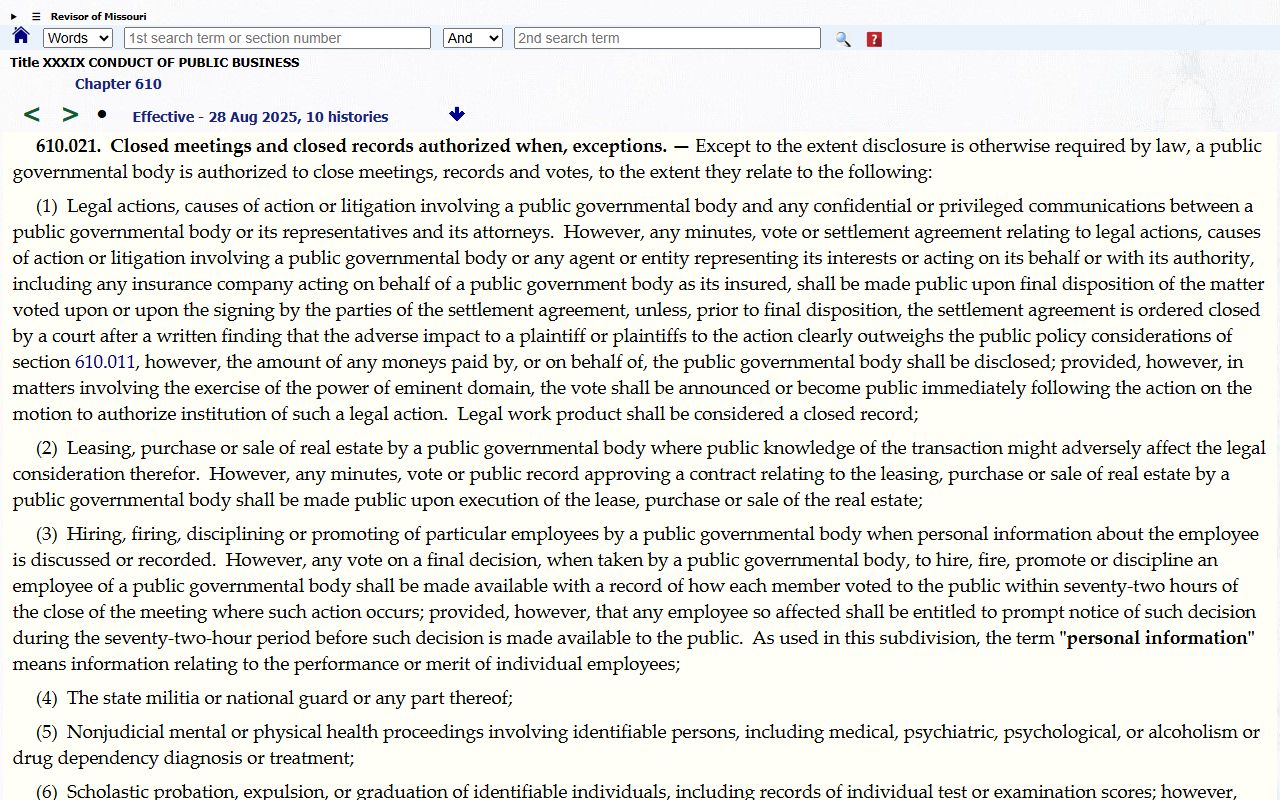
The closed-records section is the basis for closure of active investigative materials. Once a case becomes public, the docket entries open and the warrant entry shows up.
If a warrant is resolved by service or recall, the docket entry stays on the case. Expungement under RSMo § 610.140 can close the entire case file in eligible matters. The arrest record page covers the expungement deposits and the typical eligibility windows.
Municipal and Traffic Warrants in St. Louis County
St. Louis County contains dozens of incorporated cities, each with its own municipal court. A municipal warrant is issued by the city's municipal judge, not by the 21st Judicial Circuit. Case.net's municipal help says only municipal divisions on Show-Me Courts appear in Case.net; many do not.
For an unpaid traffic ticket from a city inside St. Louis County, the warrant is almost always municipal. Call the issuing city's court directly with the citation number. The clerk can confirm whether a warrant is open, what bond or fine clears it and whether a walk-in plea is allowed. The county traffic record and the state driver record from the Missouri Department of Revenue are separate files; see the traffic court records page for the full breakdown.
Failure-to-appear warrants on tickets are the most common municipal warrants in St. Louis County. Many cities will reset the case on a walk-in docket if the defendant comes to court with the citation number and current contact information.
Federal and State Warrants
Federal warrants are not in Case.net. The U.S. Marshals Service Eastern District of Missouri handles federal court orders and fugitive apprehension. The U.S. District Court for the Eastern District of Missouri at 111 South Tenth Street in St. Louis issues federal warrants on application by the U.S. Attorney's Office. Federal warrants for active fugitives often appear on U.S. Marshals public-information pages.
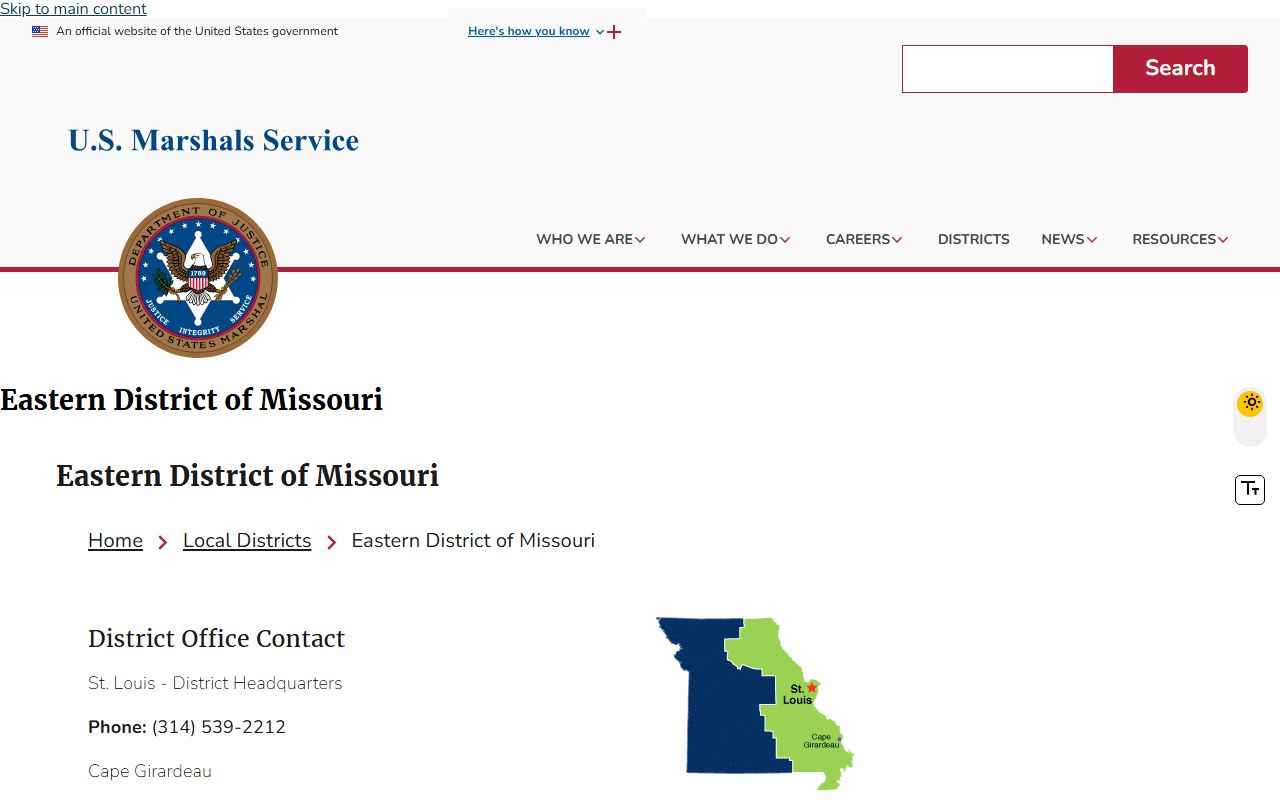
The Marshals district page lists the federal law-enforcement roles in the Eastern District, which includes both St. Louis County and the City of St. Louis. State warrants tied to Missouri Department of Corrections probation or parole are handled through DOC and the supervising court.