
What St. Louis County Probate Records Cover
Probate is the court process that handles a person's estate after death and the legal care of people who cannot manage their own affairs. In St. Louis County, the Probate Division of the 21st Judicial Circuit handles all of it. The administrative judge for probate is Hon. Nicole Zellweger in Division 5. The probate commissioner is Hon. William J. Gust in Division 66, and the deputy probate commissioner is Hon. Misty A. Watson in Division 67.
- Decedent estates and estate administration.
- Wills and will-related filings.
- Guardianships for minors and incapacitated adults.
- Conservatorships managing a protected person's finances.
- Trust registration and trust litigation.
- Mental-health and civil-commitment petitions.
- Minor estates and protected-person proceedings.
Because probate is a division of the circuit court, the records flow into Case.net like other case records, and certified copies come from the court rather than a standalone county office.
How to Search St. Louis County Probate Records
Case.net at courts.mo.gov/cnet is the search hub. Probate cases appear under the 21st Judicial Circuit. A name search pulls estates, guardianships and conservatorships tied to a party. A case-number search is the most precise when the number is known.
- Open Case.net and choose Litigant Name or Case Number search.
- Select 21st Judicial Circuit / St. Louis County in the court filter.
- Enter the decedent or protected-person name, or the case number.
- Open the case and read the Case Header, Parties and Docket Entries tabs.
- Request a certified copy from the court for legal use such as estate administration.
- For a new filing, bring the petition and supporting documents to the probate counter in person.
The local court posts probate forms for civil commitment and trust filings. A look at the official forms page is the cleanest reference for which packet matches a filing.
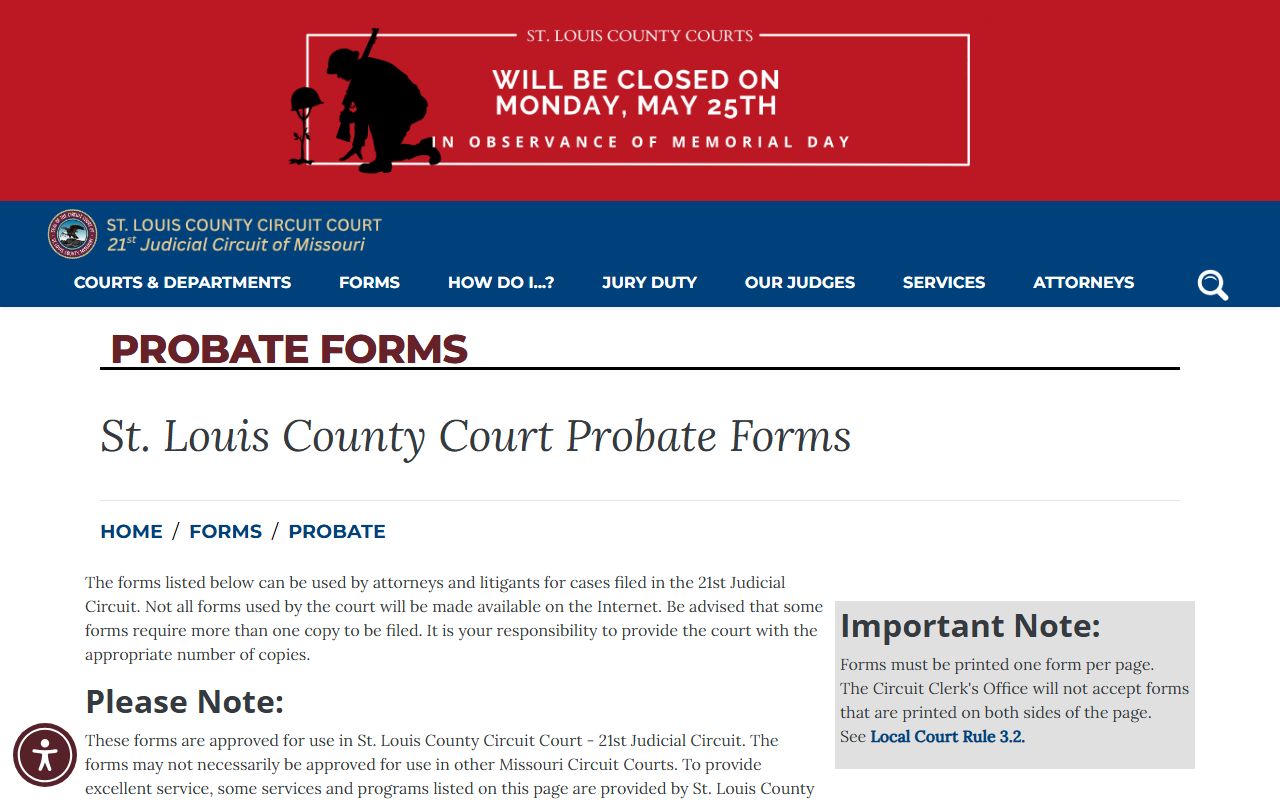
The forms page lists the 96-hour hold packet and the trust packets with their revision dates, which the clerk uses to confirm the current version.
St. Louis County Probate Terms
Probate uses words that rarely come up elsewhere. A short glossary helps when reading a docket or a will file.
- Testator
- The person who made the will.
- Executor / Personal representative
- The person the court appoints to settle the estate.
- Intestate
- Dying without a valid will; Missouri law decides who inherits.
- Guardianship
- Court authority over the personal care of a protected person.
- Conservatorship
- Court authority over the finances of a protected person.
- Letters
- The court order giving a representative power to act for the estate.
The terms map to specific docket entries. When the court issues letters, the personal representative can act for the estate; an inventory and accounting usually follow.
The St. Louis County Probate Process
Opening an estate follows a set order. The petitioner decides what kind of case it is, then files the right petition with the death certificate information, the will if one exists and the proposed representative documents. The court may issue letters, require a bond, require an inventory and accounting, and set hearings. Creditors, heirs and interested persons receive notice as Missouri probate law requires.
- Decide the case type: estate, trust, guardianship, conservatorship or mental-health matter.
- Search Case.net by name, case number or filing date to check for an existing case.
- File the petition, death certificate information, will if any, representative documents and the required deposit.
- The court issues letters, may require bond and sets inventory and accounting deadlines.
- Notice goes to creditors, heirs and interested persons.
- Final settlement and distribution closes routine estates; contested matters require hearings.
Note: A 96-hour mental-health hold packet must be filed in person at the St. Louis County Probate Court; for an emergency, call 911 rather than the court.
What a St. Louis County Probate Record Shows
A probate case on Case.net carries the standard case structure with probate-specific entries. The table below maps the common fields.
| Field | What It Shows |
|---|---|
| Case number | Probate division case identifier. |
| Decedent / protected person | The subject of the estate or protective proceeding. |
| Personal representative | Appointed executor or administrator. |
| Filing date | Date the probate petition was filed. |
| Letters issued | Court order granting authority to act. |
| Docket entries | Inventory, accountings, hearings and orders. |
| Restricted items | Mental-health and medical content not public. |
Mental-health and civil-commitment files carry medical information that is closed to the public. Estate inventories and accountings are generally public once filed, subject to redaction of protected personal identifiers.
Trust Filings in St. Louis County Probate
The Probate Division handles trust registration and trust litigation under the Missouri Uniform Trust Code. The local court forms page carries several trust packets, each with its own purpose.
- Trust Filing Under Section 456.6-604.1(3) Packet for filing a copy of a trust instrument.
- Trust Registration Packet for registering a trust with the court.
- Trusts - Adversarial, Uncontested or by Consent Packet for trust matters under the Uniform Trust Code.
- 96 Hour Hold Packet (form CCPR179-W) for civil-commitment evaluation.
Trust matters can be contested or uncontested. The right packet depends on whether all parties consent. The clerk confirms which packet and which revision applies before accepting a filing.
St. Louis County Probate Court Contact
The Probate Division sits inside the Courts Building in Clayton. Filings, certified copies and counter questions go to the courthouse.
21st Judicial Circuit Probate Division
105 South Central Avenue
Clayton, MO 63105
314-615-8029
Mon-Fri 8:00 a.m. - 5:00 p.m.
The main court number reaches the courthouse switchboard, which routes probate questions to the division. The probate counter handles in-person filings such as the 96-hour hold packet that cannot be filed online.