
Two Tracks for St. Louis County Public Records
Missouri's public-record framework runs on two tracks. Government agency records sit under the Sunshine Law in Chapter 610, RSMo. Court records sit under Court Operating Rule 2 because the judiciary controls its own records. For St. Louis County users, the practical rule is simple: use Case.net for state-court case information, request certified or older paper court files from the Circuit Clerk, use the county Sunshine portal for executive-branch county records such as police reports, and expect juvenile, adoption, mental-health, victim and sealed records to be restricted.
| Record Type | Rule | Where to Request |
|---|---|---|
| County agency records, police reports | Sunshine Law (Chapter 610) | County Sunshine request portal |
| Court case files | Court Operating Rule 2 | Case.net and the Circuit Clerk |
| Deeds and recorded documents | Recording statutes | Recorder of Deeds |
| Marriage records | Recording statutes | Recorder of Deeds |
The Missouri Attorney General's office stresses that the Sunshine Law governs whether records must be open, not what records an agency must create or keep.
How to File a St. Louis County Public Records Request
For county executive-branch records, the St. Louis County Sunshine request portal is the official intake. County Police link the portal for police records. The Central Police Records Unit at 7900 Forsyth Blvd. also handles police-record requests in person.
- Identify the office that holds the record: county agency, court or Recorder of Deeds.
- For county agency records, open the county Sunshine request portal and describe the records clearly.
- Give a date range, subject and document type to help the custodian find the records.
- Ask for a cost estimate before production if the request is large.
- Wait for the custodian response, due no later than the end of the third business day.
- For court records, search Case.net or contact the Circuit Clerk instead of the Sunshine portal.
The county Sunshine portal is the official online intake for agency records. A look at the portal shows the request form and tracking features.
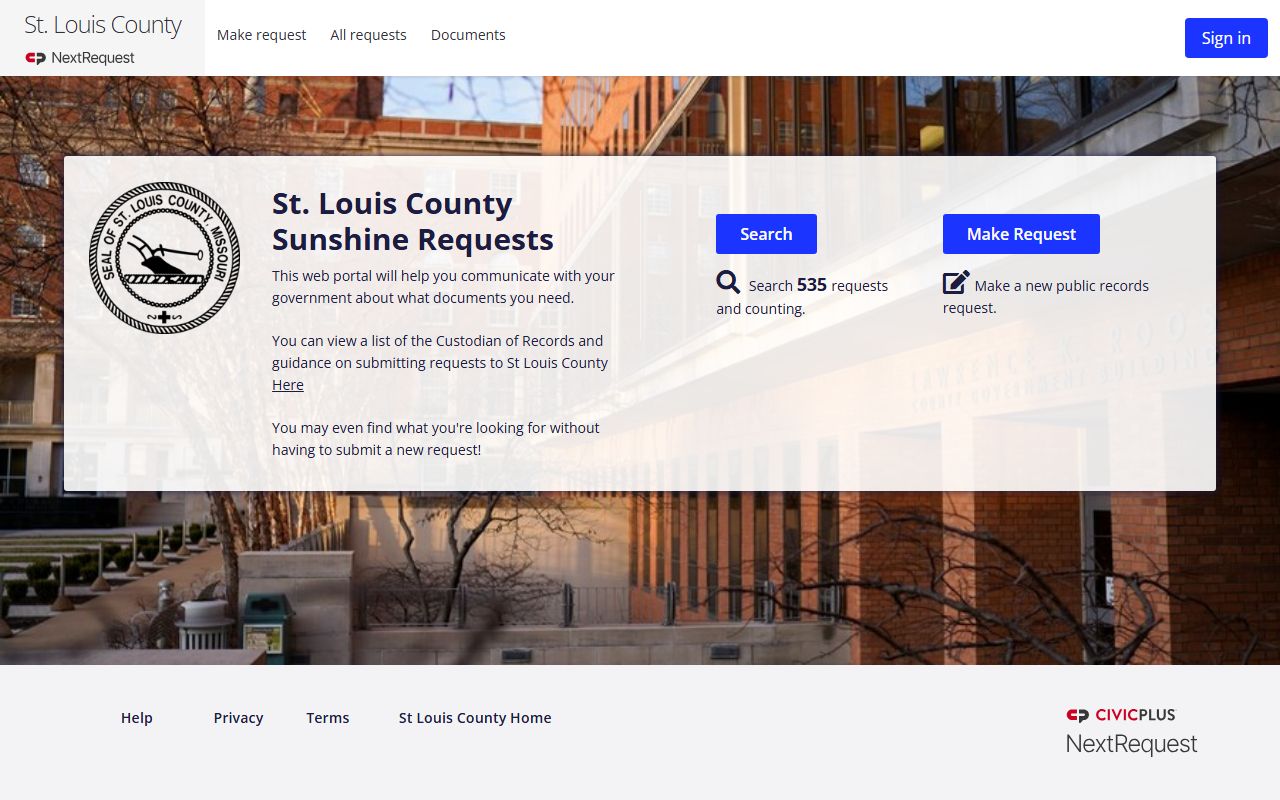
The portal lets a requester submit and track a Sunshine request online rather than mailing a letter. It routes the request to the right county custodian.
St. Louis County Public Records Response Timelines
Missouri sets a firm response window. Under RSMo § 610.023, each public governmental body must have a custodian of records, and requests must be acted on as soon as possible and no later than the end of the third business day after receipt. If access cannot be granted in that window, the custodian must give a detailed explanation of the cause for delay and the earliest date and time the records will be available.
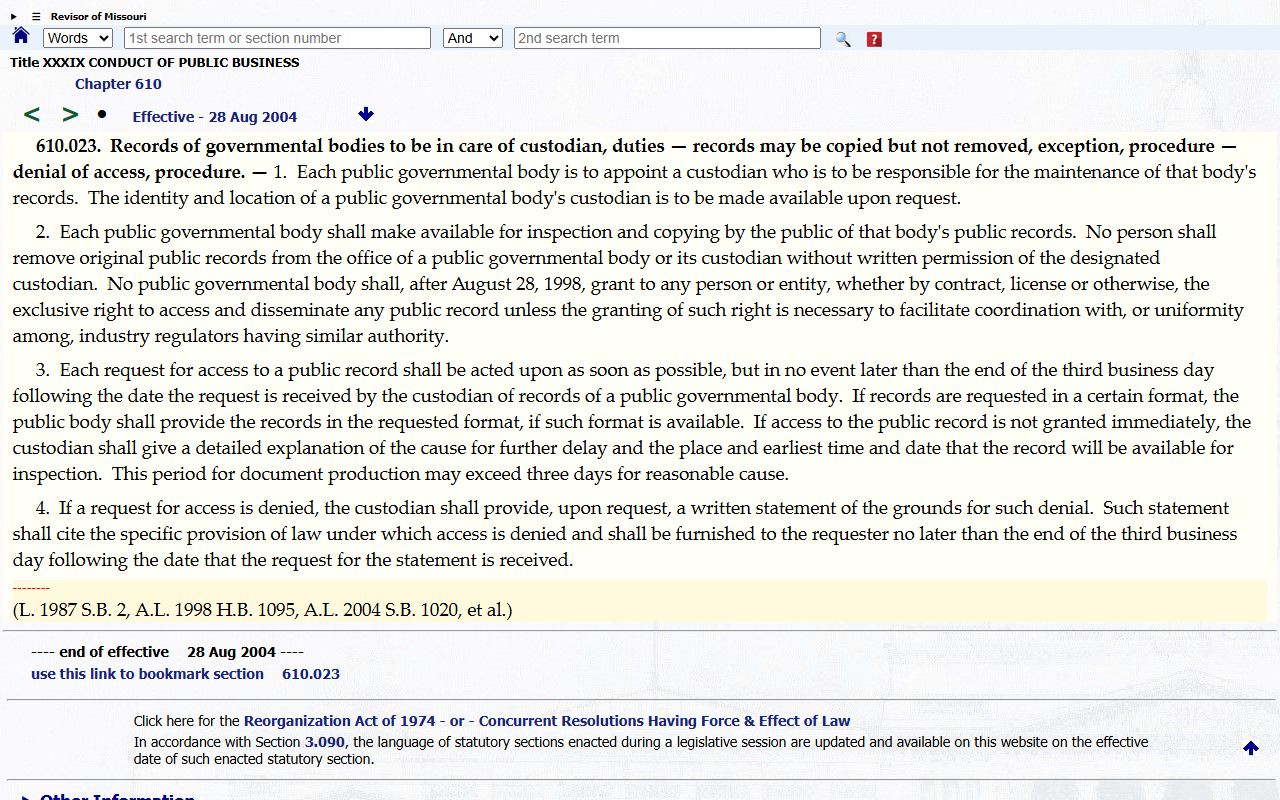
The statute is the basis for the three-business-day rule. A delay is allowed only with a written explanation and an expected date, not an open-ended pause.
Note: The three-business-day rule is a deadline to act on a request, not a guarantee that every record is produced within three days.
St. Louis County Public Records Fees
Sunshine Law fees follow RSMo § 610.026. Paper copies generally cannot exceed ten cents per page for pages no larger than nine by fourteen inches, plus clerical time at the average hourly rate. Electronic and media copies may include the copy cost, staff time, programming if needed, and media cost. A requester can ask for a cost estimate before production.
| Item | Fee Basis |
|---|---|
| Paper copy (up to 9x14 inches) | Up to $0.10 per page |
| Research / clerical time | Average hourly rate of clerical staff |
| Electronic copy | Copy cost, staff time, programming, media cost |
| Cost estimate | Available on request before production |
Court-record copies follow a separate fee schedule. The Circuit Clerk lists a certified copy of one page with seal at $1.50, additional photocopy pages at $0.30 and an authenticated copy at $3.50. Those court fees are detailed on the Circuit Clerk page.
Records Closed Under the St. Louis County Sunshine Framework
Not every record is open. RSMo § 610.021 authorizes closure for listed categories such as pending legal actions, privileged attorney communications, personnel records, certain law-enforcement records, security records and protected personal information. The exceptions do not automatically close an entire file; the public body must identify a valid exemption for the specific record.
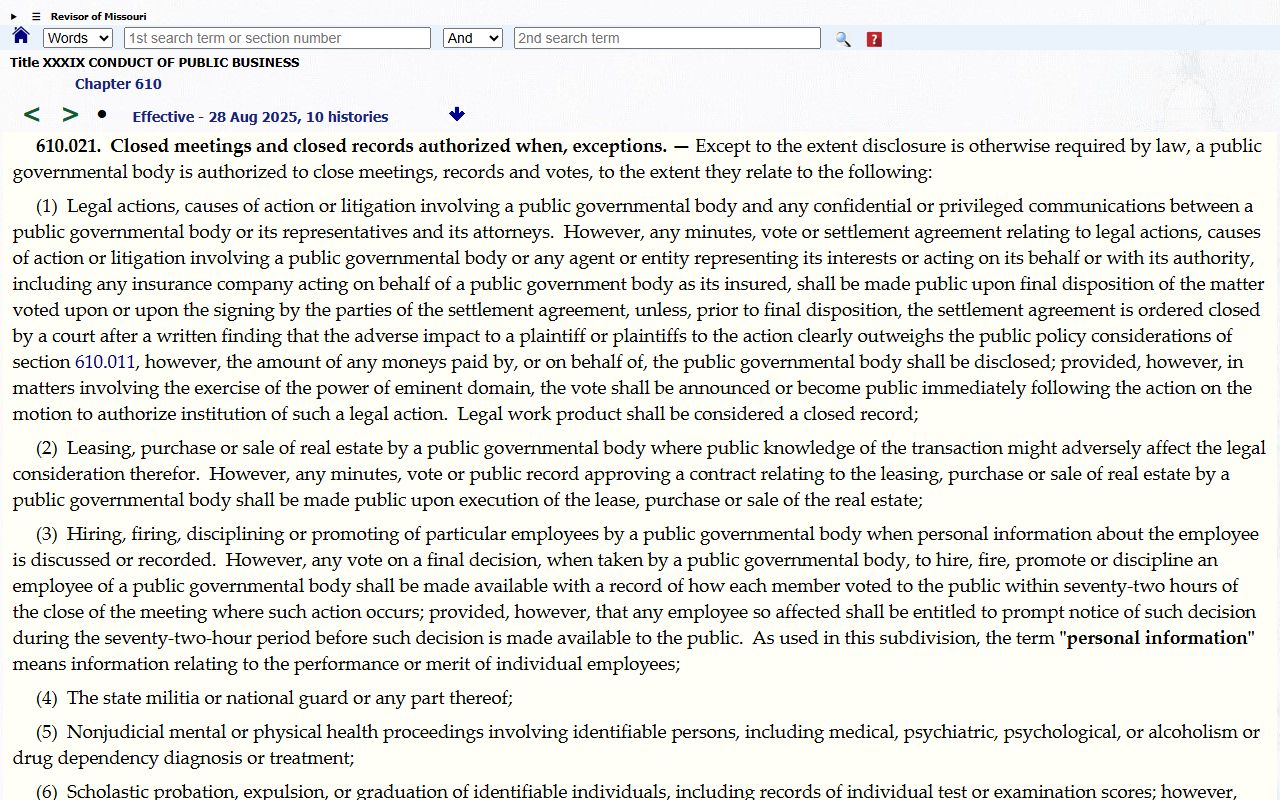
The closed-records section lists each category that allows closure. A custodian who closes a record must cite the specific provision that applies.
Other statutes close records outside the Sunshine framework. Juvenile court records are confidential under RSMo § 211.321. Expunged criminal records close under RSMo § 610.140. Corrections health and offender information is confidential under RSMo § 217.075.
The Sunshine Law Public Policy
The foundation is RSMo § 610.011, the public-policy section. It says Missouri public meetings, records, votes, actions and deliberations are open unless otherwise provided by law. It directs courts to construe openness liberally and exceptions strictly. That tilt toward disclosure is the reason most county agency records are available with a simple request.
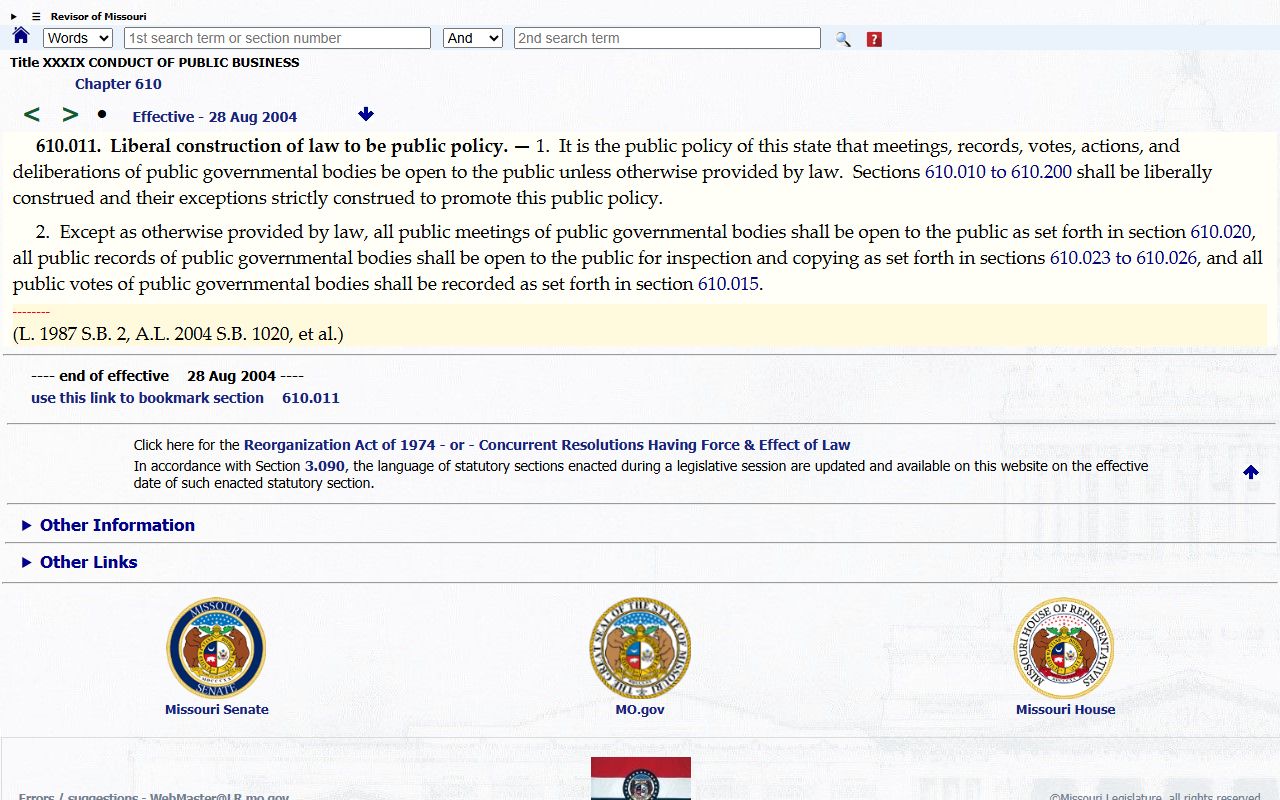
The public-policy section is the lens courts use to read every other Sunshine provision. When in doubt, the law leans toward release.
The Missouri Attorney General's Sunshine Law guidance sums up the top points, including that closed meetings must cite a specific 610.021 provision.
What St. Louis County Offices Keep
Beyond court files, county offices hold a wide range of records. The Recorder of Deeds keeps recorded deeds, liens and marriage records dating back to 1877. County Police keep incident reports, arrest records and permit files. Justice Services keeps jail records. The county executive and council keep budgets, contracts and meeting minutes.
- Recorder of Deeds: deeds, liens, marriage records, recorded instruments.
- County Police: incident reports, arrest records, permits, sex offender registration.
- Justice Services: jail operations records.
- County Council and Executive: budgets, contracts, minutes.
- Circuit Court: case files through the Circuit Clerk and Case.net.
Match the record to the office before filing. A police report goes to County Police or the Sunshine portal, a deed goes to the Recorder of Deeds, and a court file goes to the Circuit Clerk.